Inside the demanding world of modern professional sliding, victory is not merely exclusively a product of raw engine power or pilot courage. Conversely, it has evolved into a intricate engineering challenge which necessitates a meticulous fusion of choosing a inherently capable car, arming it with the correct performance components, and, most critically, understanding its live behavior on the track through cutting-edge suspension tuning applications. This definitive guide acts as your master plan from the very first idea of a drift build through to the final engineering-refined adjustments that transform a capable vehicle into a predictable champion. We will thoroughly explore the methodical process of vehicle alignment optimization, demonstrating how a modern drift tuning app like GripDial eradicates assumptions and provides exceptional visibility into your vehicle's real-world behavior.
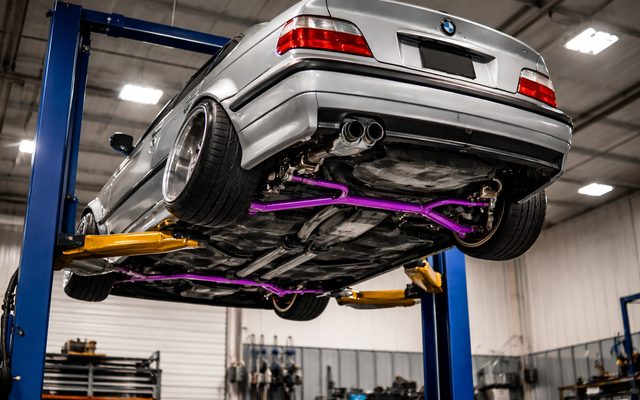
The foundation of any successful drift machine is, without question, the base vehicle itself. Certain vehicles have achieved renowned reputation within the international sliding community due to their natural balance, durable build quality, and the enormous range of aftermarket components available. Selecting the optimal platform is the primary and most crucial selection a builder will make. To illustrate, the BMW's E36 3 Series is commonly accepted as among the greatest all-around cars for drifting of all time. Its almost ideal 50/50 weight distribution, combined with a rear-wheel-drive configuration and robust inline-six powerplants, forms a platform that is both accessible for newcomers and highly competitive in the possession of a professional pilot. The next step of this philosophy, the BMW E46, improves on these qualities with a more sophisticated frame, increased track for improved confidence, and even more lock as standard from the OEM. Another powerful platform in the professional circuit is the Corvette C6.
This muscle-derived sports car brings a distinctive array of strengths to the sideways world, including a lightweight aluminum frame, a transaxle-style drivetrain component that helps create an perfect weight distribution, and the immense torque of a big LS V8 motor. This blend makes it an utter monster on track, able of entering and sustaining long drifts with apparently minimal application of throttle. For those seeking exceptional value, the Nissan 350Z excels as a excellent candidate. It is delivered from the manufacturer with a rigid body structure, a competent factory limited-slip differential, and the smooth V6 motor that delivers sufficient performance for practicing and moving up in the activity. Its newer version, the Nissan 370Z, offers more advancements in body strength, suspension design, and overall engine performance, establishing its position as a favorite choice among professional drivers. Additional legendary vehicles that merit mention are the agile Wankel-engined Mazda FC RX-7, the ubiquitous Nissan S13, the American SN95 generation Mustang, the modern BMW E90, and the tiny yet incredibly playful and instructive Mazda Miata. All of these cars provides a distinct set of attributes, difficulties, and potentials, but they all possess the fundamental components required to become a capable drift car.
However, picking the right platform is merely the beginning. To access the full performance of any of these machines, substantial changes to the steering system and chassis control systems are completely essential. This is where the realm of performance aftermarket hardware comes into critical focus. The one most game-changing modification for a purpose-built drift machine is the integration of a high-performance angle modification kit. These sophisticated systems, for example those engineered by industry leaders like specialist manufacturers, are engineered to dramatically increase the car's possible turning lock. A OEM street car is extremely constrained in how far its front wheels can rotate, a safety limitation for on-road driving. In oversteer driving, however, extreme opposite lock is frequently required to control and sustain a angle. An angle kit substitutes the OEM hubs, rod ends, and often A-arms with components that enable the front tires to attain angles beyond 70 or even 80 °, compared to a typical stock angle of around 40 to 50 degrees.
This immensely expanded capability provides the driver with exponentially enhanced command during a drift, enabling it to be much simpler to begin a slide, maintain it through a extended bend, and change fluidly from one direction to another. The difference in controllability is absolutely profound. Combined with a appropriately specified modification is the just as essential modification to the chassis's suspension. Generic or including premium sport coilovers are generally not intended for the particular and harsh requirements of sliding. A purpose-built pair of coilovers is paramount. These specialized suspension components have specific damping rates and spring rates that are optimized for the extreme mass transition that is inherent of sliding. When a driver initiates a angle, the chassis's inertia is transferred forcefully to the front of the bend. Correct drift-spec suspension control this movement in a predictable fashion, enabling the chassis to find its balance rapidly and giving the driver accurate response through the wheel and seat. They also provide exact adjustment of stance, rebound and compression stiffness, and weight balance, which are all key aspects of dialing in the vehicle's dynamics to a particular track or piloting style. As a system, a precision-engineered drift angle kit and a expertly specified pair of competition coilovers are the undeniable hardware base upon which all subsequent refinement is constructed.
Once the core components is installed, the following essential phase in the build is the detailed setting of the chassis's alignment. This is the world of vehicle alignment optimization, a process that can appear daunting to the beginner but is, in reality, the secret to turning a assembly of fast pieces into a cohesive and consistent machine. The most discussed parameter of alignment for sliding is definitely camber. Camber angle is the tilt of the rim relative to the upright line when viewed from the front-on of the chassis. If the upper part of the tire is tilted inward, this is known as inward tilt. For drifting, an inward tilt on the steering tires is universally employed and is regarded as critical. The reason is deeply related to vehicle dynamics.
When a chassis is going around a bend at extreme slip angles, the body leans to the outer of the corner. This lean forces the outside front wheel to lose its ideal grip area with the asphalt. By introducing inward lean, the tire is pre-angled to compensate for this lean. As the car rolls into the turn, the outside front tire gains a better contact patch against the road surface, increasing its traction at the exact time when it is most required for steering authority. Typically, front camber settings for a dedicated drift machine vary from approximately -3 degrees to as extreme as -5 degrees or even greater, based on the specifics of the chassis setup, tire choice, and operator feel. The back tires also use inward tilt, but the settings are generally less and subtler than the front axle. Overly aggressive camber at the back can cause the vehicle to excessively loose and difficult to predict on acceleration use, as it shrinks the available tire footprint of the driving tires during linear power delivery. Therefore, rear adjustments are frequently in the range of -1 degree to -3 degrees, striking a precise compromise between providing adequate lateral bite to help in entering and maintaining the drift while simultaneously maintaining effective hook-up for acceleration the corner. alignment is only one element of the more complex suspension geometry picture, which furthermore involves toe angle, caster, and suspension-induced steering adjustment.
Toe is the direction of the tires as seen from above. Inward toe means the front edges of the tires are closer together than the trailing edges, while toe-out means the converse. For sliding, a modest amount of front negative toe is frequently run to quicken the initial handling response, making the vehicle feel more agile and willing to begin a drift. Rear axle toe setting is generally set to zero or a incredibly small amount of positive toe to encourage straight-line stability under acceleration. self-centering is the forward or backwards inclination of the kingpin axis when observed from the side of the car. Positive positive caster enhances steering feel and high-velocity solidity, and it also boosts camber gain during steering, which is highly advantageous. Setting these parameters is a intricate dance where a change to one value can and often will affect the other settings. The traditional approach for setting a chassis's alignment for sliding has for a long time been a labor-intensive process of guesswork and adjustment. A tuner or team would make a adjustment based on intuition, run the chassis on track, rely on the driver's personal sensation and impressions, and then introduce another adjustment. This loop would continue again and again until the chassis felt "acceptable" or the scheduled track time ran out. This methodology is not only extremely slow in terms of man-hours and resources, but it is also fundamentally imprecise.
Human feel is a infamously inconsistent metric, colored by numerous variables such as tiredness, varying track surfaces, ambient heat, and simply the mood of the driver on that particular day. What feels "loose" on one lap might feel "pushing" on the subsequent pass, causing contradictory information and ineffective changes. This long-standing challenge in car suspension tuning is precisely where modern telemetry systems has made its mark to transform the landscape.
The development and adoption of sophisticated vehicle dynamics tools has ushered in a new paradigm for tuning and refining competitive drift cars. This new generation of tools, represented by innovative systems like modern telemetry hardware, operate by directly recording the live physical performance of the car as it is being driven on the course. In contrast to depending on subjective impression, these tools acquire quantifiable data on essential variables such as shock absorber movement, corner velocities, G-force loading, lock position, and throttle and brake input. This raw telemetry is then analyzed by powerful applications that can graph and interpret the metrics in a comprehensible manner. For the first time ever, engineers and builders can observe specifically what the vehicle is exhibiting at every point of a drift. This function transforms the complete suspension tuning workflow. Consider the aforementioned challenge of setting the front negative camber for a particular chassis. As an alternative to making a modification from -3 degrees to -3.5 degrees and then driving several laps to try and "sense" a improvement, a vehicle dynamics tool can give immediate and clear information. The software can display in a chart how the tire's grip is acting during the critical stages of a angle: initiation, sustain, and switch. It can reveal if the current angle is enabling the loaded tire to maintain maximum grip or if the compound is overloaded on its outside shoulder.
The software can after analysis make empirical suggestions for modification. Perhaps the information shows that the tire is still stressing its sidewall at -3.5 degrees of camber, suggesting that an increase to inward lean, say -4 degrees, might be warranted. Alternatively, the information might show that the tire is not coming up to optimal operating temp or that the inside edge is wearing too quickly, which could point to drift telemetry software that there is too much negative camber and a small reduction back to -3.2 degrees would be better efficient. This standard of precision and practical insight was simply unattainable in the days of solely manual setup.
The effect of using a advanced suspension tuning tool goes well beyond just dialing in camber angles. It serves as an invaluable coilover setup tips that is tailored to your exact car. When setting the shock absorber clickers on your suspension, rather than depending on vague advice or copying another car's numbers, you can employ the data to observe how the chassis is performing in reaction to your changes. The tool can display the damper movement trace over a lap, highlighting if the coilovers are managing the weight transfer effectively or if they are causing the chassis to oscillate excessively after a transition. It can aid in identifying problems like excessive compression or losing droop, enabling you to apply informed adjustments to helper springs, damping rates, or stance. This methodology applies just as well to the complex art of suspension geometry optimization. Beyond camber angle, the tool can provide analysis into how adjustments to toe and caster angle are impacting the vehicle's balance during different parts of a slide. For instance, it can assist you to determine the ideal amount of front negative toe for your particular angle kit configuration and driving technique by measuring the response time of turn-in suspension tuning tool response and the predictability of the car at lock lock. This makes the tool an incredibly effective drift suspension tuning guide that is actively updated by the real-world dynamics of your personal chassis on the track. It shifts the complete endeavor from a subjective skill into a repeatable development exercise.
Moreover, the application of a system like modern telemetry is in no way limited to expert engineers with vast resources. For the club-level driver, it serves as an powerful force multiplier. It practically offers the tuner with the insight of a full-time suspension specialist without the corresponding overhead. It accelerates the learning curve by giving definitive answers to problems that would normally take seasons of experience to answer. A builder can see how their individual chassis reacts to different settings, building a deeper comprehension of vehicle dynamics in the endeavor. It furthermore opens up professional performance tuning techniques, permitting all drivers with the drive to refine their car to do so in a structured and effective manner. This is particularly important in a sport like sliding, where tuning expertise has in the past been a highly secretive advantage among professional crews. In the modern era, that knowledge can be in the hands of any dedicated builder.
In the final analysis, the process to constructing and dialing in the perfect championship-contending drift machine is a multi-stage endeavor that seamlessly combines proven hardware wisdom with cutting-edge digital solutions. It starts with the wise selection of a proven car, then built upon the integration of critical performance parts like high-performance steering angle kits and properly selected performance adjustable dampers. The process then moves into the intricate realm of car suspension tuning, where values like camber angle, toe, and caster angle are carefully adjusted to complement the car's new hardware and the pilot's specific style. Ultimately, and what genuinely separates the modern process from the traditional methods, is the use of a advanced suspension tuning application. This system eradicates the uncertainty and inefficiency of solely subjective adjustment by providing empirical, real-time information on how the vehicle is really performing. It functions as an unparalleled engineering partner, a comprehensive drift suspension tuning guide, and a comprehensive vehicle dynamics tool. As a complete package, this holistic philosophy ensures that each and every component of the drift machine—from the pick of the chassis to the last tweak on the damper—is refined for ultimate competitiveness on the competition venue. It represents the complete progression of the sport of sliding, connecting raw car control with data-informed chassis drift telemetry software dynamics to forge the perfect effective cars attainable.